
The Structural Emergency
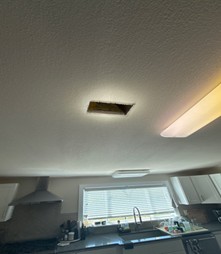
If you are standing in your kitchen looking up at a stain, you aren’t just looking at a cosmetic issue. You are looking at a gravity problem. This is because water doesn’t stay where it starts. If a pipe leaks in an upstairs bathroom or a drain line fails behind a wall, that water follows the easiest path down. By the time it reaches your kitchen ceiling, it has already traveled through your floor joists and saturated your insulation.
If your kitchen ceiling, flooring or cabinets appear compromised, stop wondering if they will dry on their own because they won’t. The water is trapped behind a layer of paint that acts like a plastic bag, keeping the moisture locked against your structural beams. In most cases, you have to open it up to save the house.
The Path of Water: Tracking the Moisture Trail
Water is lazy but persistent. It always follows the path of least resistance, which is rarely a straight line. If you have a leak from an upstairs shower pan or a toilet seal in your master bath, that water doesn’t just drop into your kitchen. It hits a floor joist, runs along it, finds a wall cavity, and then starts its journey into your hallways and closets.
When we walk into a home in San Antonio, we aren’t just looking at the obvious puddle. We start by performing forensic moisture mapping. This is how we track the moisture trail that the naked eye can’t see. We are looking for where the water wicked into materials that look perfectly dry on the outside but are rotting on the inside.
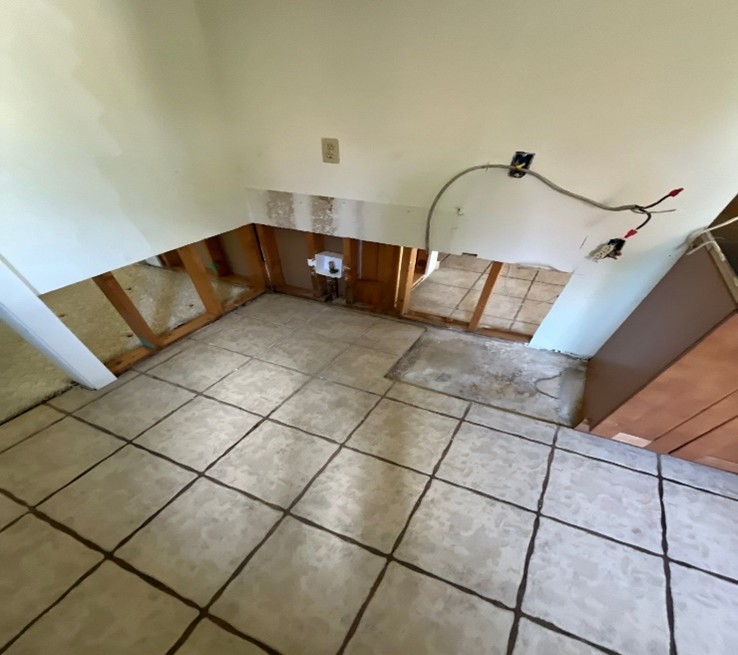
As we pull back the baseboards, you can see exactly what we mean. In most cases, you’ll notice the bottom of the wall studs are darker than the rest of the wood. This is wicking in action. Wood is like a sponge; it drinks water from the floor and pulls it upward. If we don’t catch this, you end up with structural rot and mold growth behind your walls where you’ll never see it until the smell starts.
This is also why you see us making flood cuts. We usually cut the drywall about two feet up from the floor. We do this to expose the wall cavity and the subfloor transition. This is because water often travels under the transition strips between your kitchen tile and your hallway wood floors. It hides under the thresholds, sitting there in the dark where there is zero airflow.
From a project management and insurance standpoint, this tracking phase is the most critical part of the job.
- For the Insurer: They require a moisture map to justify why we are cutting drywall in a room that looks fine. Without this data, they may refuse to pay for the necessary demolition in adjacent hallways.
- For Valuation Experts: Documentation is everything. Having a file that proves the water trail was tracked and dried to the subfloor protects the home’s Class A status and prevents it from being flagged as a mold house in the future.
If you only fix the ceiling and ignore the trail leading to the hallway closet, you are only doing half the job. Water is a traveler, and our job is to find everywhere it decided to stop.
The Cabinet Debate
This is an issue we deal with in almost every kitchen restoration job from San Antonio to Austin. If your cabinets are made of particle board or MDF, which is common even in high-end homes, they act like a sponge. Once that material swells, it’s structurally compromised and can’t be dried back to its original shape. Even with custom solid wood cabinets, the real danger is the dead space behind the box. If we don’t pull them, we’re often leaving a perfect breeding ground for mold right against your drywall.
The Salvage vs. Replace Debate
Here, we don’t just look at the wood; we look at the whole room’s continuity.
- For the Homeowner: If we replace two damaged lower cabinets but the new stain is just a shade off, your kitchen’s resale value takes a massive hit.
- For the Insurer: Their goal is to return your home to pre-loss condition. In Texas, this is governed by the reasonably uniform appearance standard. This means they can’t just give you a close enough match if it breaks the visual flow of the room.
- For Valuation Experts: A mismatched kitchen is the first thing a home inspector or appraiser will flag. It signals that the home wasn’t restored professionally according to IICRC S500 Standards, which can lead to thousands of dollars in buyer’s credit requests later.
Whether we are saving a custom set or pushing for a full replacement, the goal is the same: your kitchen should look like the leak never happened. We aren’t here to give you a patch job; we’re here to protect the investment you’ve made in your home.
Containment & 2026 Tech
This is where a standard “remodel” and a professional “restoration” truly drift apart. When we start cutting out water-damaged drywall or pulling up moldy baseboards in your kitchen, we are releasing millions of invisible particulates, dust, fiberglass insulation, and potentially mold spores, into the air. Without proper containment, your kitchen island isn’t the only thing getting dirty; your entire home’s air quality is at risk.
For our containment walls, we use a floor-to-ceiling plastic barrier. This isn’t just to keep the dust off your couch. We use a negative air pressure setup. By placing an industrial air scrubber inside that plastic “bubble” and venting it out a window or door, we create a vacuum. This ensures that every time someone walks in or out of the work zone, air is pulled into the kitchen rather than blowing contaminants out into your living room or bedrooms.
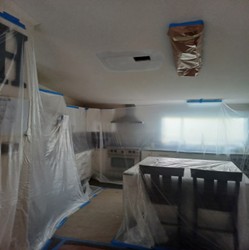
Why Containment is Your Home’s Best Defense
- For the Homeowner: It’s about maintaining livability. You shouldn’t have to deep-clean your entire house because of a leak in the kitchen. Containment keeps the construction zone exactly where it belongs.
- For Tenants: If you are renting out a property in San Antonio or Austin, proper containment is often a legal requirement to ensure the habitability of the rest of the unit while repairs are underway.
- For Insurers: They look for loss mitigation. By using professional containment, we prevent cross-contamination, which keeps the claim from ballooning into a whole-house cleaning bill.
- For Local Authorities: In older Central Texas homes (built before 1978), containment is a matter of federal law. Under the EPA’s Lead Renovation, Repair, and Painting (RRP) Rule, any disturbance of lead-based paint requires specific lead-safe containment and HEPA-filtered vacuuming to protect the occupants and the environment from toxic dust.
If a contractor walks into your kitchen with a sledgehammer and without a roll of plastic and an air scrubber, stop them immediately. They might fix the leak, but they’ll ruin your air quality in the process.
The Extras of Kitchen Restoration: Beyond the Water Line
When doing a kitchen restoration, we aren’t just fixing the aftermath of a burst pipe. A true restoration looks at the entire ecosystem of the room. Often, the best time to address aging infrastructure or inefficient systems is when the walls are already open and the containment is already in place. Here are the non-water-related upgrades that turn a standard repair into a high-performance kitchen.
Mechanical Restoration: The HVAC Overhaul
In many Central Texas homes, the kitchen is the primary distribution hub for the home’s air. If your system is pushing 20 or 25 years old, it’s likely inefficient and potentially compromised.
- System Lifecycle: A 25-year-old unit isn’t just an energy hog; it often harbors decades of accumulated dust and microbial growth. Replacing a system of this age can improve efficiency considerably, while simultaneously enhancing your kitchen’s air quality.
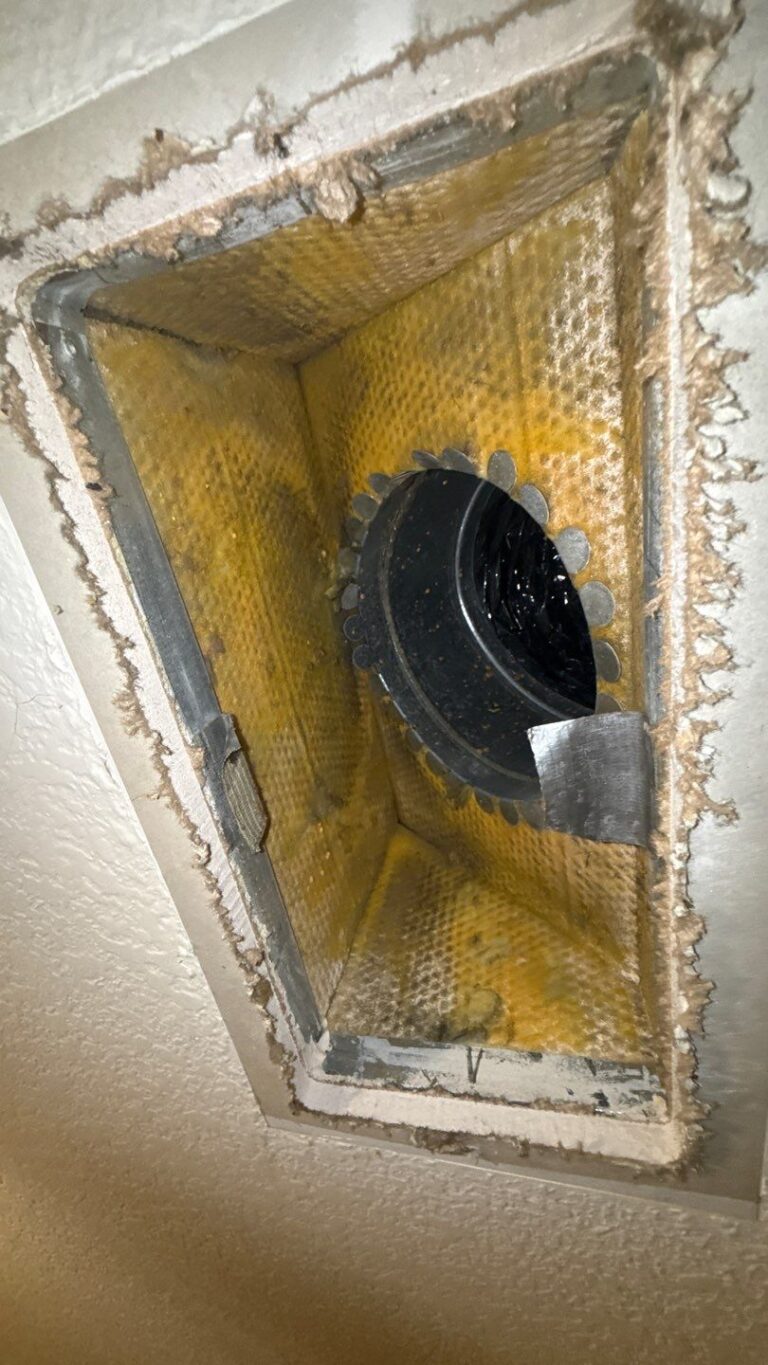
- Plenum & Register Replacement: We don’t just swap the unit; we replace the plenum boxes and registers. This ensures that the last mile of air entering your kitchen is passing through clean, modern components rather than rusted or dusty legacy metal.
Electrical & Lighting Upgrades
If we’ve removed a water-damaged ceiling, it is the perfect opportunity to bring your kitchen’s electrical systems up to 2026 standards.
- LED Integration: We often replace old, heat-generating recessed cans with modern, energy-efficient LED wafers.
- GFCI Compliance: Under NFPA 70: National Electrical Code (NEC), kitchens require specific GFCI protection for all countertop outlets. We ensure that your restored kitchen isn’t just beautiful, but fully code-compliant and safe for your family.
Structural & Aesthetic Improvements
- Subfloor Leveling: Before new flooring goes down, we often perform subfloor grinding or leveling. This ensures that your new tile or LVP (Luxury Vinyl Plank) doesn’t click or crack over time.
- Cabinet Refacing vs. Replacement: If your cabinet boxes are structurally sound but the style is dated, we can integrate refacing into the restoration process. This provides a new kitchen look at a fraction of the cost of a full gut.
Kitchen Restoration & Mechanical Upgrades: Your Questions Answered
When you are dealing with a kitchen crisis or a major mechanical failure, you need straight answers. Here are the most common questions we hear from homeowners across Central Texas.
Does insurance pay for a full kitchen cabinet replacement if only the bottom ones are wet? In Texas, this often comes down to the line-of-sight rule. If your cabinets are custom or have a specific finish that cannot be perfectly matched with a new spot repair, the insurer is generally required to provide a reasonably uniform appearance. This means if a partial fix looks like a patch job, they may be responsible for replacing the entire run, uppers and lowers, to maintain your home’s value.
Can mold in my kitchen HVAC vents make me sick? If you have a 20+ year old system and see black spotting on your kitchen registers, you aren’t just looking at dust. Microbial growth inside your HVAC unit can distribute spores throughout your entire home every time the A/C kicks on. This is why we treat HVAC replacement as a restoration priority; you have to stop the source of the contamination to protect your family’s respiratory health.
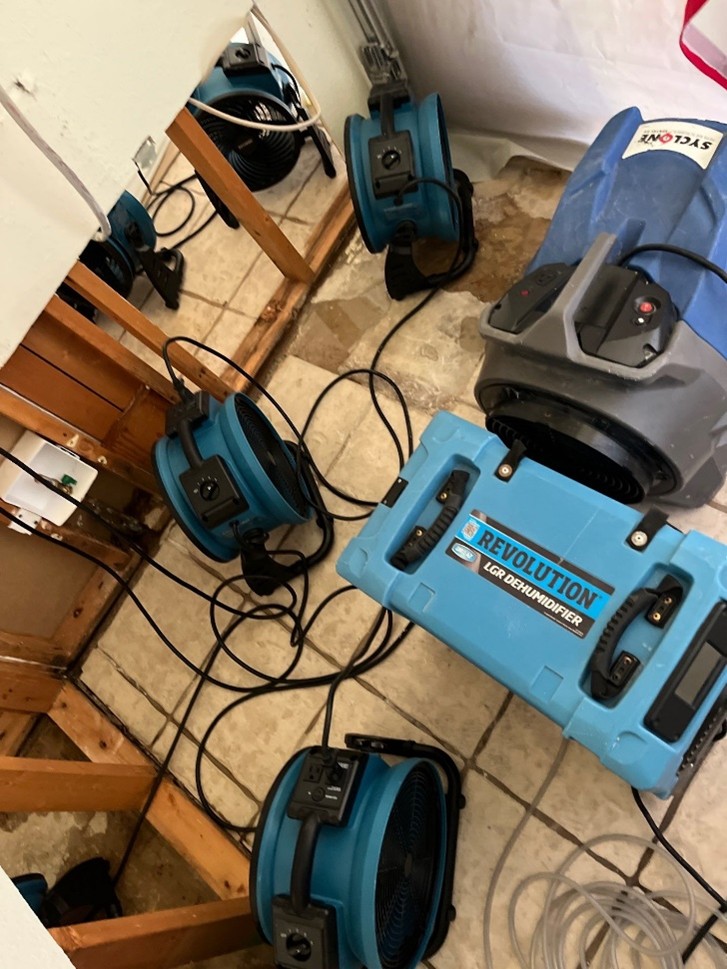
How long does it take to dry out a kitchen after a leak? A professional dry down typically takes between 3 to 5 days. We don’t just air dry the room; we use industrial dehumidifiers and air scrubbers to pull moisture out of the structural wood and subfloors. If you don’t hit the dry standard before putting back new cabinets, you are essentially sealing mold into your walls.
The Bottom Line: Professional Standards Matter
A kitchen restoration is a major investment in your home’s future. Whether we are tracking a moisture trail through your hallways or overhauling a 25-year-old HVAC system that has reached its limit, our goal is to return your home to a state that is better, safer, and more efficient than it was before the damage occurred.
Ready to Restore Your Kitchen?
Don’t let a simple leak or an aging A/C unit turn into a long-term liability for your home. If you are in Austin, San Antonio, or the surrounding Hill Country and need an expert eye on your kitchen’s structural or mechanical health, let’s talk.
Contact Hayden Restoration Today
We don’t just patch and paint; we restore your home’s health from the studs up.